Posts

Chemistry revision sheets

Alkene Synthesis (Part 4)
Image
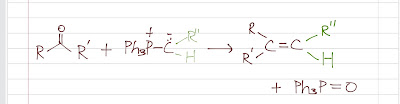
                                          Wittig Reaction Wittig reaction turns a carbonyl ( compound that has C=O) to an alkene by reacting a carbonyl (aldehyde or ketone) with a phosphorus ylide . It is a very useful reaction that turns a C=O to a desired C=C. Making ylide Let's talk about the phosphorus ylide . It has no overall charge, but it has a negatively charged carbanion that is bonded to a positively charged phosphorus. It is prepared by a two-step reaction sequence - an SN2 in which a triphenylphosphine attacking an unhindered alkyl halide (making a positively charged phosphorus), followed by a proton abstraction by a strong base (usually butyllithium ). We know that Phosphorus and Sulfur can form more than 4 bonds using the d orbitals . One may think that the ylide should have a double bond instead of having the carbon and phosphorus ch...
Alkene Synthesis (Part 3)

Image
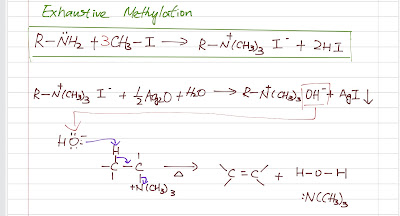
Hoffman elimination and Cope elimination are amine chemistry. Both reactions are concerted and both favor the Hofmann product (less-substituted alkene). Hofmann Elimination  Leaving group  The general form of an amine is R-NH2. The amide ion is a strong base hence a poor leaving group. So if we want an amine to undergo an elimination, we have to make a better leaving group first. We do this by exhaustive methylation (usually with methyl iodide) to convert the leaving group into a quaternary ammonium salt which can leave as a neutral amine. E2 Mechanism Hofmann elimination follow a E2 , concerted reaction mechanism which needs a strong base . The geometry is specific here (like a typical E2): anti-coplanar between the proton being abstracted and the leaving group. The quaternary ammonium salt is reacted with silver oxide to become a hydroxide salt to generate the strong base needed. Heat is applied and the Hofmann product is the major product.  Hofmann Eli...

Alkene Synthesis (Part 2)

Image
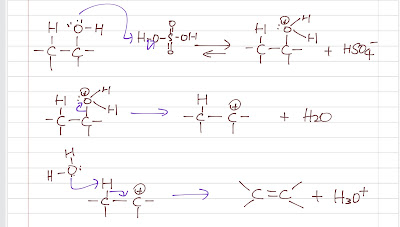
Dehydration of alcohols This is a reversible acid-catalyzed reaction. In fact, it is a common way to turn an alkene  into an alcohol. To increase the yield of the product, the alkene  produced is usually distilled off (an alkene has a lower boiling point than its alcohol due to the lack of hydrogen bonding) to shift the equilibrium to the product side. Concentrated sulfuric acid is used as a catalyst to protonate the -OH group to a better leaving group, H2O. Then, a E1 mechanism is followed: 1. ionization (water leaves) to a crabocation 2. a weak base (water or HSO4-) abstracts the proton to form an alkene.  Dehydration of alcohol Cracking (alkane) An industrial (large scale and least expensive) way to make alkene is by the catalytic cracking of alkane (e.g. petroleum). A long chain of alkane is heated with catalyst (e.g. platinum) to form small alkenes (around 6 carbon atoms). This process of dehydrogenation is endothermic, but it has a positive entropy change...

Alkene Synthesis (Part 1)

Image
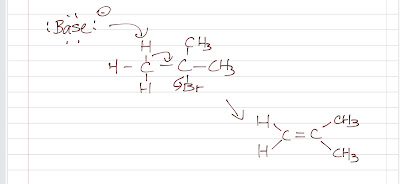
Alkene can be synthesized by a various ways. Alkene can be made from a carbonyl , alkyne , alkane , alchols , alkyl halide and vicinal dibromides and other elimination reactions. We will split the 7 methods of alkene  synthesis into 4 parts. Part 1: Alkyl halide and vicinal   dibromide Part 2: Alcohol,  alkyne  and alkane Part 3: Hofmann & Cope Elimination Part 4: Wittig Dehydrohalogenation of Alkyl halide  We already talk about how to synthesize alkene from a E2 (E1 is not considered because it often produces a mixture of SN1 and E1 products) reaction. Dehydrohalogenation of a alkyl halide is actually another name describing the same reaction we previously discussed in the E2 section. The alkyl halide loses a proton and a leaving group with a formation of an alkene . Remember that it is a stereospecific reaction (anti-coplanar) and the Zaitsev product is the major product (the opposite of a Zaitsev product is a Hofmann product, which i...

Stability of Alkene

Image
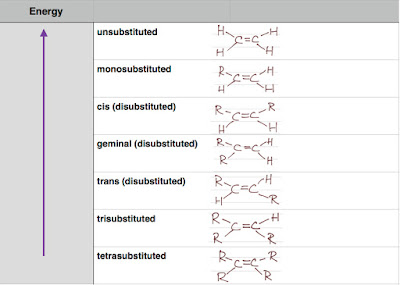
From Zaitsev's rule, we know that a more substituted alkene is more stable. For an alkyl disubstituted alkene, which of the cis or trans isomer is more stable? Since the substituted alkyl groups are further away from each other in the trans isomers, the trans isomers are usually more stable. For a halogen disubstituted alkene, the trans isomer will have the dipole moment canceled out and the cis isomer with strong dipole moment as the electronegative halogen groups are on the same side. Below is a table showing the energy of a series of substituted ethene. A higher energy alkene is less stable. 

Orbitals of Alkene

Image
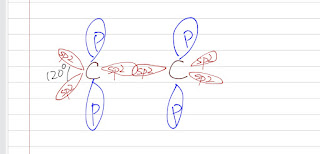
Alkene is a hydrocarbon with a double bond two carbon atoms. Before we can go further on the reactions of alkene. Let's briefly talk about the orbitals of a alkene. Orbitals A double consists of one sigma bond and one pi bond. There are 4 electrons in a double bond.   Sigma Bond: There are 6 electrons in a carbon atom: 2 in the s orbitals and 4 in the p orbitals. Take a look of ethene, one carbon is bonded to a carbon and to two hydrogen atoms and there is no lone pair of electrons at the carbon. This implies a sp2 hybridization (120º bond angle) . Each C-H sigma bond is the overlap of a sp2 hybridized orbital on carbon with the 1s orbital on hydrogen. There is also a overlap of the sp2 hybridized orbital between the two carbon (yes, the C-C double bond has one sigma bond). This sigma bond here is shorter  than the sigma bond fond in ethane because it has more s character (sp2 hybridized) than the sp3 hybridized. Pi Bond: There is an unhybridized p orbital in ea...

E1 E2 Comparison

Image
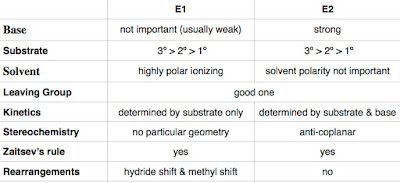
Let's compare E1 and E2 in the following aspects: Base Substrate Solvent Leaving Group Kinetics Stereochemistry Rearrangements  Base E1: As the base abstracts the proton only after the carbocation intermediate is formed, it does not affect the rate of reaction, hence not important. E2: A strong base is indeed needed to promote the one-step reaction. Substrate E1: A more substituted substrate stabilizes the carbocation intermediate.  E2: A more substituted substrate forms a more substituted alkene.  Solvent E1: A polarizing solvent enhances the rate of ionization as it pulls the cation and anion apart.  E2: The transition state is less sensitive to the solvent as the transition state has its negative charge shared over the whole molecule.  Leaving Group Both reactions need a good leaving group.  Kinetics E1: The rate is only determined by the substrate as it is the only molecule that ionizes. E2: Both the substrate and the base aff...