What Is a Catalyst? How Reactions Get a Shortcut
Some reactions that should happen barely crawl along — until you add a pinch of the right substance and they suddenly race. That substance isn't a reactant and it isn't used up. It's a catalyst, and it's one of the most useful tricks in all of chemistry (and biology).
The short answer: a catalyst is a substance that speeds up a chemical reaction by providing an easier pathway with a lower activation energy, without being permanently used up itself. Because it's regenerated at the end, a tiny amount of catalyst can help enormous amounts of reactant react, over and over.
What a catalyst actually does
Every reaction has an energy "hill" the reactants must climb before they can turn into products — the activation energy. A catalyst doesn't push the reactants harder; it offers a lower hill by giving the reaction an alternative route. More reactant particles have enough energy to get over a smaller hill, so the reaction goes faster.
An analogy: imagine hikers who must cross a mountain range. A catalyst is like discovering a tunnel through the mountain — the hikers (reactants) still start and end in the same places, but far more of them make it across, and much faster. The tunnel isn't consumed; it's there for the next group too.
Two important limits:
- A catalyst speeds up a reaction but does not change how much product you can ultimately make, nor does it change whether the reaction releases or absorbs energy overall (its ΔH is unchanged). It only changes the rate.
- A catalyst is not consumed. It may take part partway through, but it's returned to its original form by the end, so it doesn't appear in the overall balanced equation.
Everyday and industrial catalysts
- Catalytic converters in cars use platinum and palladium to turn toxic exhaust gases into safer ones.
- Iron catalyzes the Haber process that makes ammonia for fertilizer.
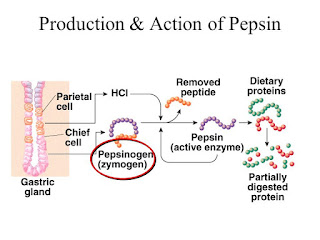
- Enzymes are biological catalysts — proteins that speed up the reactions in living things. Your own pepsin catalyzes the breakdown of proteins in your stomach; without it, digestion would be impossibly slow.
That last one is the bridge between chemistry and biology: an enzyme is just a catalyst your cells build out of protein.
A worked mini-example
Hydrogen peroxide (H₂O₂) slowly breaks down into water and oxygen:
2 H₂O₂ → 2 H₂O + O₂
On its own this takes ages. Add a little manganese dioxide (MnO₂) — or the enzyme catalase from a piece of liver — and it fizzes vigorously as oxygen pours off. Weigh the MnO₂ before and after and it's unchanged: it sped the reaction up without being used up. That's a catalyst in action.
Common mistakes to avoid
- Thinking a catalyst is a reactant. It isn't consumed and doesn't appear in the overall equation — it's a helper, not an ingredient.
- Believing a catalyst makes more product. It only makes the same product faster. The final amount and the overall energy change stay the same.
- Assuming catalysts only speed things up "a bit." Enzymes can accelerate reactions millions of times — the effect is often dramatic, not subtle.
FAQ
What is a catalyst in simple terms?
A catalyst is a substance that speeds up a chemical reaction by lowering its activation energy, without being used up in the process.
Is a catalyst used up in a reaction?
No. A catalyst is regenerated by the end of the reaction, so a small amount can be used again and again and it doesn't appear in the overall equation.
How does a catalyst speed up a reaction?
It provides an alternative pathway with a lower activation energy, so more reactant particles have enough energy to react, increasing the rate.
Are enzymes catalysts?
Yes. Enzymes are biological catalysts — proteins that speed up reactions in living organisms, such as pepsin breaking down proteins in the stomach.
The takeaway
A catalyst is a reaction's shortcut: it lowers the activation-energy hill so the reaction goes faster, then walks away unchanged to do it again. From catalytic converters to the enzymes running your body, the same idea makes slow chemistry practical — speed without being spent.
Next up → [What Is Activation Energy?] — the hill a catalyst lowers. See also [What Is Pepsin?] and [Endothermic vs Exothermic Reactions].

Comments
Post a Comment